Clear direction for fiction writers
book marketing strategy service
Marketing that finally adds up to a career.
Stop guessing, and start marketing your book intentionally. Before you add another social account, design another graphic nobody sees, or spend money on ads, you need a plan backed by real data. My actual party trick is picking up patterns, remembering odd stats, and refusing to recommend a single task without telling you exactly why you need to do it.
Party trick is generous. It is more of a compulsion.
Chapter 01
The plot problem
For authors doing the work, but unsure whether it’s leading anywhere.
You’re not bad at marketing. The order is wrong.
You’re posting, sending, maybe even launching, and none of it feels like it’s adding up to a career. Your website, newsletter, and socials were never decided in the right order, so they can’t talk to each other. I fix the order before you spend another month of energy on it.
Chapter 02
The short version
Know what you are buying before you buy it.
Every package on this page is a written document you keep, so you are never frantically transcribing a call afterward. Here is what is inside one.
What you get, at a glance
- A written document, not a call you have to rememberDelivered in about two to three weeks, and it stays yours to work from.
- Who your book is for, decided rather than guessedGenre and reader positioning, plus what your cover and bio should signal.
- The platforms worth your energy, and the ones that are notNamed and ranked, with the reasoning written next to each one.
- The fixes ordered by what they are worthWhat is working, what is leaking, and what comes first.
- A sequence to follow, instead of a menu to choose fromThe decisions already made, so next month has a shape before it starts.
Which of these you get depends on the package you pick below. All four arrive written down.
Chapter 03
The reading order
Every one of these is something you keep.
Each of these is booked on its own, at the price printed on it. Take the one that fits where you are, and hand me the next when you’re ready for it.
i
What’s included
A written positioning document you can build the next year around, usually delivered about two weeks after I have your manuscript and access. It answers who this book is for, what your cover and bio should signal, which platforms are worth your energy before launch, and what to do in what order.
- Author brand foundation
- Genre and reader-audience positioning
- Platform priorities
- A recommended pre-launch action plan
Debut Author Positioning Strategy
$550
once-off
For writers preparing for first publication who need a clear launch foundation.
i
What’s included
A written audit of everything you already have running, plus a plan that ranks the fixes by impact, usually within two to three weeks. It answers what’s working, what’s leaking, what’s actively costing you readers, and which three fixes come first.
- Platform, messaging, visual-identity, discoverability and channel reviews
- A prioritized strategy document
- Recommended next steps
Author Brand Audit and Strategy
$750
once-off
For authors whose marketing exists in pieces but doesn’t feel like one connected system.
i
What’s included
A written social system you can run yourself indefinitely. It answers which platforms deserve your time, what to post, and how any of it leads back to a book.
- Platform focus, content pillars and posting cadence
- Caption structure and hook frameworks
- How social connects to books, newsletters, launches and backlist
Social Media Content Strategy
$350
once-off
For authors who want to manage their own social but need a clearer system first.
i
What’s included
One focused call on a single question, whether that’s platform choice, launch timing, or “is my current setup sane?” You leave with the decision made.
Strategy Consult Call
$75
the small door in
For authors who need focused direction on one decision without a full strategy document.
Chapter 04
The delivery notes
What happens, and what you walk away with.
The Timeline
Most strategy engagements run about four to six weeks end to end. It starts the moment I have your manuscript and access, and it ends with the finished document in your inbox. A single consult call is same-week. You will always know which stage we are at.
What You Walk Away With
A written document you own and keep, in plain language you can act on the same week. It opens with what I found, then a ranked list of moves, each with a plain reason and a rough sense of effort, so you know exactly where to start and where to stop if your budget or energy runs out partway down.
No Long-Term Commitment
The strategy document is the deliverable. There is no retainer to sign and nothing you are locked into. Take the plan and run it yourself, which plenty of authors happily do, or hand the building back to me piece by piece.
The proof
The sample chapter
What a strategy saves you from.
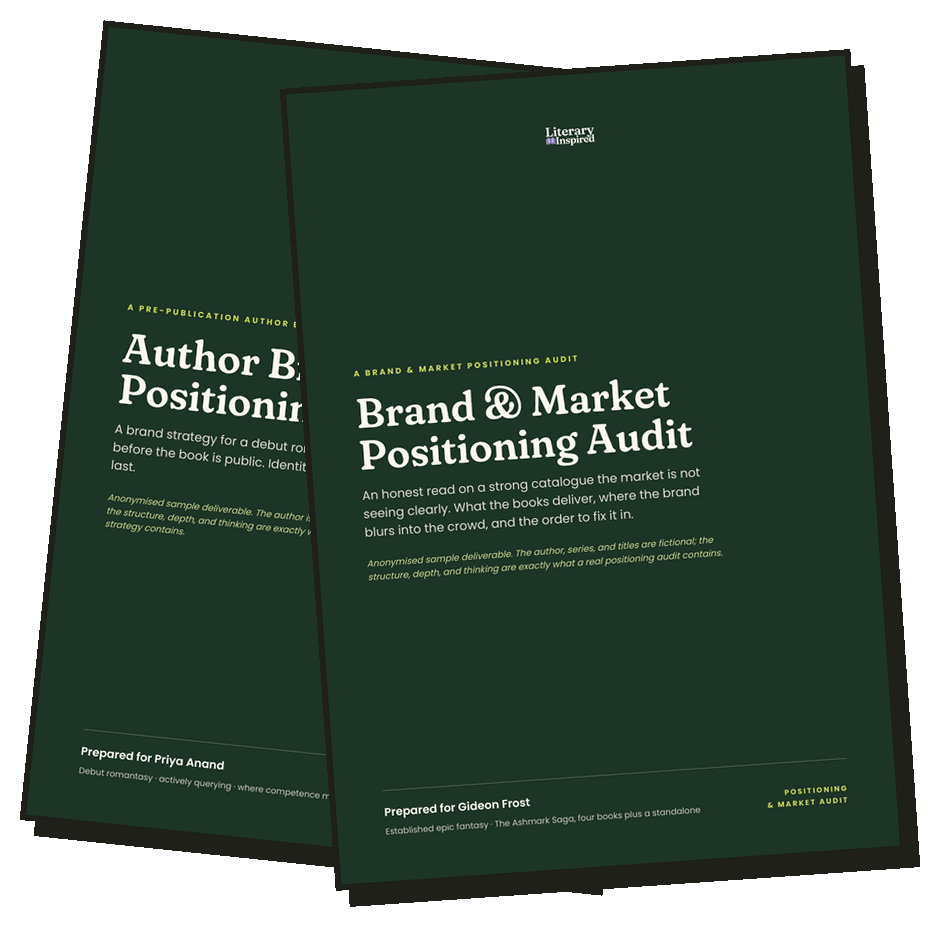
A month of posting into the void, an ads budget spent on the wrong platform, a website built before anyone decided what it was for. This one was written for a fictional debut, so nothing in it belongs to a client.
Book marketing strategy · sample deliverable
- Thirteen pages you can act on the same week, not a slide deck.
- Every move ranked by impact, with the reasoning written next to it.
- A rough effort estimate on each one, so you know where to stop if the budget runs out partway down.
- The decisions already made, in order, instead of a list of options to choose between.
Written for an author who does not exist. The thinking is the same thinking you would get.
Footnotes
Before you buy a single thing
Asked often. Answered honestly.
Is this just a document, or do you build it too?
Both, if you want. The strategy services deliver the thinking and the plan. If you’d like it built, ARC campaigns, website, newsletters, social, those are separate services and I can take on any or all of them. Strategy first, build second, always in that order.
I’m a debut with no platform yet. Is it too early for strategy?
It’s the perfect time. Getting the foundation and the sequence right before you build anything saves you from tearing it down and redoing it later. The Debut Author Positioning Strategy exists for exactly this moment.
How is this different from generic marketing advice online?
Generic advice has never read your book, doesn’t know your genre, and has no idea what stage your career is at. This is built for you specifically: your manuscript, your listing, your readers, with a plan made for your situation, not a generic one with your name pasted on top.
What if I just have one question?
Book the $75 Strategy Consult Call. It’s built for a single focused decision, whether that’s platform choice, launch timing, or “is my current setup sane?”
Can strategy really move sales, or is it just planning?
Strategy is the thing that makes your execution pay off. A post with nowhere to send readers, a newsletter with no reason to stay, an ARC list with no conversion plan, these fail because the strategy underneath them was missing. Fixing the order is often the single highest-return thing an author can do.
Stop buying in the dark
You don’t need another course. You need the order.
No perfect brief required. Promise.
Keep reading: what a book marketing strategy service decides
The document that saves you from buying the wrong things
The fear I hear most often about strategy is that it’s the service where you pay for a nicely formatted PDF, nod along, file it, and never open it again. Fair fear, because that’s exactly what a lot of “brand sessions” turn out to be. So here’s the standard I hold myself to: the plan has to change what you do next. If it doesn’t tell you something you can act on Monday, and tell you what to stop doing as clearly as what to start, it hasn’t earned its price. A strategy that only lengthens your to-do list has failed. Its job is to shorten it.
What makes that possible is that I’m not handing you general advice. I’ve read your book, looked at your listing, your site, your list, and your socials, and I’m ranking your specific gaps by what will move your career most. Anyone can give you twenty things you could do. Deciding which three matter for this book, at this stage, is what saves you money, because every month spent building in the wrong order is a month you pay for twice.
What’s in the strategy, and what isn’t
Because “strategy” can mean almost anything, here’s the physical shape of what you’re buying. It’s a written document, not a recorded call you have to mine later for the useful thirty seconds. It opens with what I found: how your positioning currently reads to a real reader, where your platforms agree and where they contradict each other, and how your listing holds up against what it’s sitting next to. Then it moves to the part that earns the fee, a ranked list of moves, ordered by what will shift your career most, each with a plain reason and a rough sense of effort, so you can see exactly where to start and where to stop if your budget or energy runs out partway down.
What it isn’t is a dump of everything you could theoretically do. I could generate that in an afternoon and it would help you not at all, because the problem was never a shortage of options. It’s also not a generic plan with your name dropped into the header. Two authors in the same subgenre get different plans, because the value is in reading your situation rather than the average of everyone’s. If a strategy could have been written without opening your book, it wasn’t worth writing.
The decisions a brand strategy makes
“Brand strategy” sounds abstract until you see the questions it settles, which are all concrete and most of which you’re currently answering by drift. What do readers reliably get from your books, and can you say it in one sentence a stranger would understand? Which corner of your genre are you really competing in, and which authors would a reader name in the same breath as you? What should your cover, your bio, and your feed all be signaling, so that someone who meets any one of them recognizes the same author behind the other two? And given all of that, where does your limited time go first?
None of those are decorative. They decide whether a reader who liked one of your books can tell at a glance they’ll like the next, and whether your marketing reads as one author or scatters into unrelated impressions. Every downstream piece inherits the answers. Your blurb, your keywords, your captions, your newsletter voice, your website copy all get faster and sharper once there’s a fixed thing to write against. Settle them on purpose and your marketing stays coherent as it grows. Leave them to improvisation and each new piece drifts a little further from the last until nothing quite matches.
Where you are decides what you need
Two authors ask me for “strategy” and mean opposite things, so the first thing I work out is which one you are. If you’ve got books out, several platforms, a launch or two behind you, and a nagging sense it isn’t adding up, the problem is rarely effort. It’s that nothing was decided against a shared position, so the website, the newsletter, and the socials can’t reinforce each other. That’s what the brand audit is for: I go through the whole setup, tell you what’s working and what isn’t, and hand you a plan that closes the gaps in priority order.
If you’re pre-publication, there’s nothing to audit yet, and auditing marketing that doesn’t exist would just be theater. What you need is the foundation defined correctly before you build a single thing, so your debut launches from a clear position instead of a blank one. Getting that right early is what spares you the classic debut fate: a website, a newsletter, and a social presence that each pull in a slightly different direction because none of them were decided together. If you genuinely can’t tell which situation you’re in, that uncertainty is itself the answer. Book the consult call and we’ll place you inside twenty minutes.
Why paying for planning first usually costs less
It feels backwards to spend on thinking before you spend on anything you can see. Visible deliverables feel like progress; a plan feels like a delay. But the sequencing is where the money leaks. An author who commissions a website before settling positioning almost always rebuilds it once the positioning clarifies what the site should have said. An author who grows a following before there’s anywhere to send it spends months feeding a channel that can’t convert. Start with strategy and you build each piece once, in an order that compounds, which usually works out cheaper than the tactical route even though it doesn’t feel that way at the checkout.
This is also why strategy sits comfortably in front of everything else I offer. The plan is a map, and a map only matters if someone can make the journey. Take the document and execute it yourself and that’s a completely legitimate outcome, one plenty of authors choose and enjoy. Hand the building back to me and nothing gets lost in translation, because the person doing the work already understands the reasoning from the inside.
What I’ll tell you that you might not want to hear
Part of what you’re paying for is a straight answer, including the ones that cost me the sale. Sometimes the honest read is that your marketing is fine and your cover is the problem, or that your blurb is working against a book that’s genuinely good, or that the real hook is buried three chapters deep while the marketing keeps promising the opening. Those are conversations I can only have because I’ve done the reading, and I’d rather send you off to fix the real thing than bill you for a plan that dances around it.
And I won’t pretend strategy is a magic switch. It doesn’t manufacture readers who were never going to like your book, and it can’t rescue a listing with the wrong cover on it. What it does is make sure that when you do spend energy and money, they go into the work that carries a career rather than the work that only looks busy. If you’ve been putting in the hours and still feel like you’re guessing, the problem is a missing plan. Tell me where you are, and we’ll get the order right before you spend another month on the wrong end of it.