Service
Social Media Marketing
You didn’t become a writer to spend Tuesday night making graphics.
Social media management for authors who’d rather be writing: monthly management, graphic packs, reels, group promotions, and an evergreen bank that keeps posting while you disappear into a draft. The feed stays consistent, and the Tuesday-night dread stops.
Disappear into the draft. I will keep the lights on.
Chapter 01
The endless scroll
Consistent, and connected to the rest of your marketing.
A feed falls apart when it’s sporadic, generic, and floating off on its own with no link back to your books.
I handle both halves, consistent and connected, so your feed keeps working through launch weeks, drafting months, and the inevitable stretch where you have precisely zero energy for it.
Chapter 02
The short version
A month of posts that you did not have to think about.
Whichever pieces you take below, this is what stops being your problem.
What you get, at a glance
- Captions written from your book, not from your titlePulled out of the actual text, which is why they sound like your book.
- Graphics that match the rest of your brandSame colors, same type, same author, whichever platform they land on.
- A posting rhythm that survives a drafting monthScheduled ahead, so a bad week does not become a silent month.
- Every post pointing somewhere that sells a bookThe link back to a listing or a newsletter is built in, so nobody has to remember it.
- The first three posts a new reader meets, decidedPinned as a set, so your profile introduces you before you have to.
Take one piece or take all of it. The captions come from the book either way.
Chapter 03
The line-up
Start with one piece. Add the others as they earn their place.
There’s genuinely no need to buy everything at once, and I’d rather you didn’t.
i
What’s included
Three to five posts a week, written in your voice, designed, and scheduled, so your platform stays active between launches without you touching it.
- 3 to 5 weekly posts, written and scheduled
- Captions in your voice
- Ongoing platform presence
Ongoing presence
Social Media Marketing
$250
per month
For authors who want a consistent presence without writing posts every week.
i
What’s included
A one-time setup builds a deep content bank per book; the optional monthly recycling schedules and rotates it, and the recycling fee never rises with the size of your catalog.
- Evergreen Setup: 15 original captions plus 35+ graphics, for 525+ content variations
- Monthly Evergreen Recycling: scheduling and rotation of your evergreen pool
Backlist engine
Evergreen Social
$120
setup per book · recycling $150/month
For authors with a backlist that should keep selling without new content each month.
i
What’s included
Single graphics, reels, and organic promo you can book on their own or bolt onto a package.
- Graphic Pack: $75 for 9 custom book marketing graphics (launches, ARC, preorder, cover reveals, backlist)
- Reels Pack: $75 per 5 reels
- Facebook Group Promotions: $180
- Meta Suite Setup: $75
- Community Management: $70
- Facebook Group Management: $80
On demand
Graphics & Extras
from $70
à la carte
One-off pieces you can add any time, with no retainer attached.
Top of profile
The pinned three
The first three posts a new reader ever sees.
Pinned posts do the introducing: who the author is, what they write, and where to start. I build them as a set, not as three separate posts.


Serenity Rayne


Rochelle L. Wilcox


Mary Elizabeth Summer


Heather Grace Stewart


Dave Bartell


Beatrice Bradshaw


Dia Beckett


M Kay Noir


Literary Inspired
Chapter 04
How the pieces fit together
Every piece does a different job.
Social media works better when it has a job. Each piece below has one.
Monthly Management
Your current, active presence: fresh posts tied to what’s happening now, a launch, a sale, a new chapter of the story you’re telling readers. It keeps you in the conversation this month.
Evergreen Systems
These keep your backlist alive without you paying for new content every month. I build a reusable bank once, then rotate it, so a book you released last year stays in front of readers while your attention is on the next one.
Graphic Packs
The assets for a specific push, a launch, a cover reveal, a preorder, a backlist spotlight, when you need nine polished pieces for one moment rather than an ongoing rhythm.
Facebook Group Promotion
This does the reaching: getting your book in front of genre readers who aren’t following you yet, in the groups where they already gather. It’s the piece that brings in readers who were never going to find you on your own feed.
Community Management
Tends the readers you already have. I post, reply, welcome new members, and keep comments and DMs from going cold on your own group or page. It’s the difference between an audience that feels looked after and one that slowly drifts.

Chapter 05
The writing room
Pulled from the text, not generated from the title.
Every caption comes from the book itself: the real tropes, the lines readers underline, the promise the story makes.
Generic social is why so much author marketing gets scrolled past. Specific is what stops the scroll.
I take the underlining extremely seriously. It is, technically, the job.
Chapter 06
Held in a hand
Nobody meets your feed on a desktop.
A reader finds you at a set of traffic lights, thumb already moving. What they see is nine tiles at once, and they decide from that whether you look like an author with a shelf or an author with a hobby. So that is the size I design at, and the size you should judge the work at too.
Go on. Hover it. It stops for you.


In the feed
Posts I’ve made
What it actually looks like in the grid.
Real client graphics, pulled from the book and built to stop the scroll, not stock templates with a title dropped on top.


Two dozen author feeds built and kept running, every tile drawn from the book it’s selling.
The proof
A month, planned
The plan behind the posts, not just the posts.
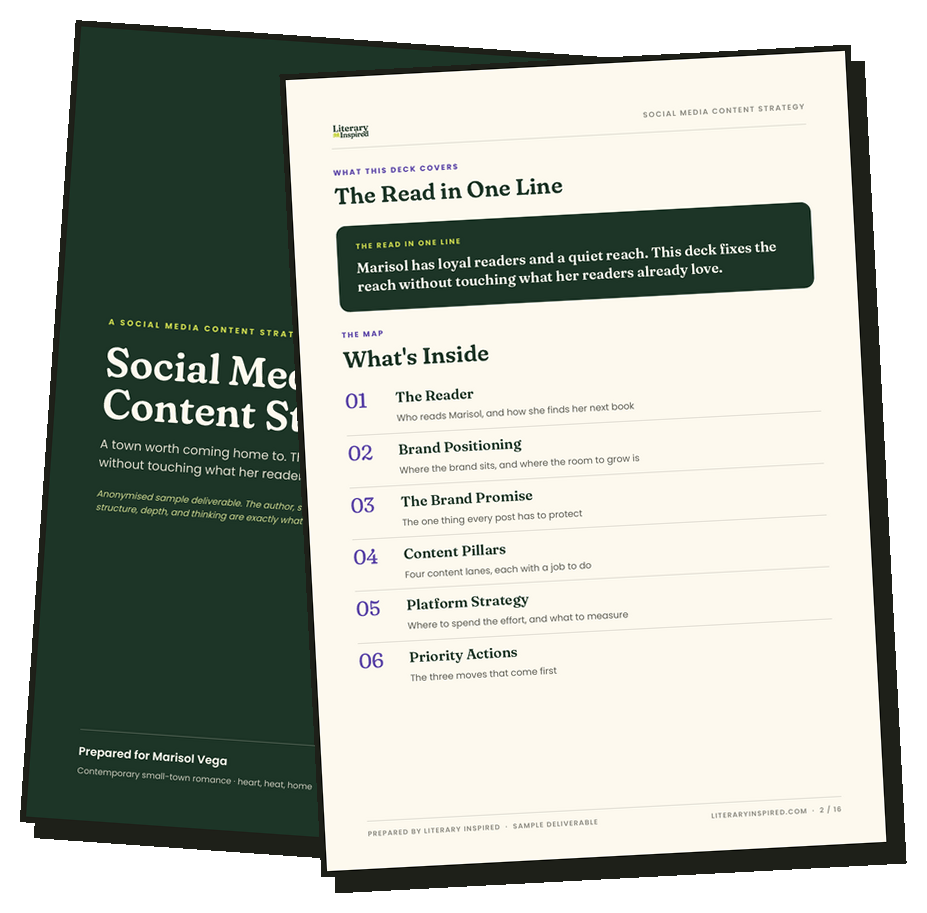
This is the deck an author gets when I take social on: who the reader is, what the account is for, the pillars everything is written against, and what to do first. Built for an author who does not exist, so nothing in it belongs to a client.
Social media content deck · sample deliverable
- The reader described specifically enough to write a caption to.
- Content pillars, so “what do I post today” stops being a daily decision.
- How a post connects back to a book, every time, by design.
- What to post first, and what can wait a quarter.
The posts are the easy part. This is the part that makes them add up to something.
Footnotes
Before you hand over the grid
Asked often. Answered honestly.
Do I have to be on every platform?
Please, no. Part of the job is working out which platforms are worth your energy for your genre and your readers, then doing those properly, instead of spreading yourself thin across all of them and burning out.
I feel like I’m already failing at this. Is it too late?
It’s not, and you’re not failing. You’re a writer who got handed a second job and told to be “authentically visible” with no plan and no time. That’s not a personal failing, it’s a setup nobody could win, and it’s exactly what management fixes.
I hate being on camera. Do I have to show my face?
No. Plenty of the author accounts I run never show a face. They work off graphics, book content, and the writing itself. If being on camera drains you, I build around it.
Who writes the captions, and do they sound like me?
I do, from your book and your voice. Authors consistently say the copy sounds like their book, because it’s pulled from the text itself rather than guessed from the title and cover.
What’s the difference between evergreen setup and a graphic pack?
A graphic pack is 9 graphics for a specific need. Evergreen setup is a reusable bank of 15 captions plus 35+ graphics, designed to be recycled indefinitely. Different jobs: one is a burst, the other is an engine.
Can you manage my Facebook group or reader community?
Yes. Facebook Group Management and Community Management cover posting, engagement, member management, and comment and DM support on your own channels.
What if my cover changes after you’ve made the graphics?
For authors on Monthly Evergreen Recycling, there’s no change-order fee. I pause posts for that book so nothing goes out with the old cover, then refresh the graphics over time as part of the service.
Will social media alone sell my books?
No single channel sells books on its own. Social works best plugged into the rest of your marketing, driving readers toward a website and newsletter that catch them. If you’ve only got budget for one thing right now, strategy usually comes before social.
Stay visible while you draft
The feed keeps going even when you can’t.
Nothing here needs you to feel inspired on a Tuesday.
Keep reading: what social media management for authors really involves
What You’re Handing Off
Hand someone your social media and you’re handing off more than the posting. You’re handing off the deciding. Which platforms are worth your presence at all. What to say on them that’s true to your books rather than true to the genre in general. How often. And the part most people skip, where each post is trying to send the reader. A feed that grows followers but never points them at a book, a newsletter, or a launch is a hobby with good production values. The posts are the visible part; the value is in the calls underneath them.
The reason to hand it off is almost always consistency, because that’s where doing it yourself breaks. You post with real energy for three weeks, then a deadline or a brutal drafting stretch lands, and the feed goes dark for two months. To a reader and to the algorithm, that gap reads as gone, and it quietly undoes most of what the good weeks built. A managed feed keeps moving through your busy stretches precisely because it doesn’t depend on how much energy you have that particular week. It’s also the appeal of an evergreen bank: solid content built once and rotated keeps your backlist visible for months without asking you to invent something new every time you sit down.
Why specific captions beat generic ones
The most common failure in author social media is captions that could describe any book in the genre. “A love that defies the odds.” “A world where nothing is as it seems.” “You won’t be able to put it down.” These are technically about a book, but they’re specific to none, and readers scroll straight past them because they’ve seen the same words on a thousand other posts. Captions that work are pulled from the book’s specifics, the particular trope the way this author executes it, the line a reader would underline, the exact promise this story makes and no other. That specificity is what stops the scroll, because it signals to the right reader that this book is for them in a way a generic caption never can. A caption that could only describe this book cannot be written from a blurb.
A specific caption converts better. It attracts readers who want what the book offers, instead of a vague audience that will never buy. Multiply that across months of posts and the compounding effect is significant: a feed of specific, book-true content slowly builds an audience of genuine potential readers, while a feed of generic content builds a follower count that never turns into sales. Given that both cost the same to produce, specificity is close to a free win.
How social fits the rest of your marketing
Social media is a reach channel: its job is to help readers discover you. But reach without anywhere to land is wasted, which is why social is the last thing you should buy on its own if you can help it. The ideal setup has social posts driving readers to a website where your books and series order are clear, and to a newsletter that captures interested readers so you’re not paying to find the same person twice. In that chain, social is the top of the funnel, the website is where interest becomes a sign-up, and the newsletter is where a sign-up becomes a repeat reader. Bought alone, social can still build presence and support launches, but it works far harder than it should, because the readers it earns have nowhere to go. This is why, for an author with limited budget, the honest recommendation is often to get the foundation and strategy right first (the full order is written out here) before investing heavily in social, so that when social does run, it’s feeding a website and newsletter that can hold the readers it brings in. If you want your feed to stay consistent, sound like your books, and connect to the rest of your marketing instead of shouting into the void, that’s exactly what this service is built to do.
Do you actually need social media as an author?
It’s a fair question, and one too few authors ask, and no: not necessarily, and not everywhere. Social media is one reach channel among several, and for some authors it’s genuinely not the best use of limited energy. If you write in a genre whose readers don’t discover books on a given platform, or if content creation drains you to the point that it damages your writing, forcing a daily presence can cost more than it returns. There’s no rule that says a successful author must be personally active on every network, and plenty of careers run largely on newsletters, retailer visibility, and ARC-driven launches with only a light social footprint. So the first strategic decision is not how to do social, but whether and where, and the useful answer depends on your genre, your temperament, and whether you have the foundation to catch the attention social brings.
Where social does make sense, the goal is sustainability over intensity. A feed that runs consistently at a modest pace, and keeps running through your busy months, beats a feed that burns bright for three weeks and then goes silent, because inconsistency reads as absence to both readers and algorithms. This is why evergreen systems and management exist: they decouple your presence from your weekly energy, so the posting continues when you’re deep in a draft or simply out of enthusiasm. Deciding whether you need social, and if so choosing one or two platforms to do well rather than five to do thinly, is itself part of the strategy work, and it’s a far better starting point than the guilty assumption that you must be everywhere at once.
The numbers worth watching, and the ones that lie
One of the most useful shifts an author can make about social media is to stop measuring it by follower count and start measuring it by what it contributes to the career. Followers, likes, and reach are easy to see and emotionally satisfying, which is exactly why they’re misleading; a large following that never clicks through, never joins the newsletter, and never buys a book is a vanity metric. The metrics that matter are the ones tied to your own platforms: how many people the feed sends to your website, how many of those join your newsletter, and how the audience shows up when a launch happens. A smaller, engaged, genre-matched following that converts is worth far more than a big, passive one, and chasing raw growth often actively works against conversion by attracting people who will never read your books.
This reframing changes how the content is written. If the goal is genuine conversion rather than applause, every post is built around a real job: name what a book does, drive a click, deepen a specific reader’s interest, rather than around what might rack up likes. That’s why specificity beats generic reach-bait: a caption pulled from the book itself attracts the reader who will love it, while a generic viral-style post attracts a crowd that will scroll past your next release. Managed well, social becomes a targeted top-of-funnel that feeds the parts of your marketing that make sales, instead of a scoreboard you tend for its own sake. If you’d like your social presence built and measured that way, specific to your books and connected to the rest of your marketing, tell me where you are and we’ll work out which platforms are worth your energy and how social fits the bigger picture.